- Book excerpt
- Behavioural Science
- Improving Decisions about Health, Wealth and Happiness
I. Introduction
People can be greatly influenced by small changes in the context and the influence can be exercised for better or worse.
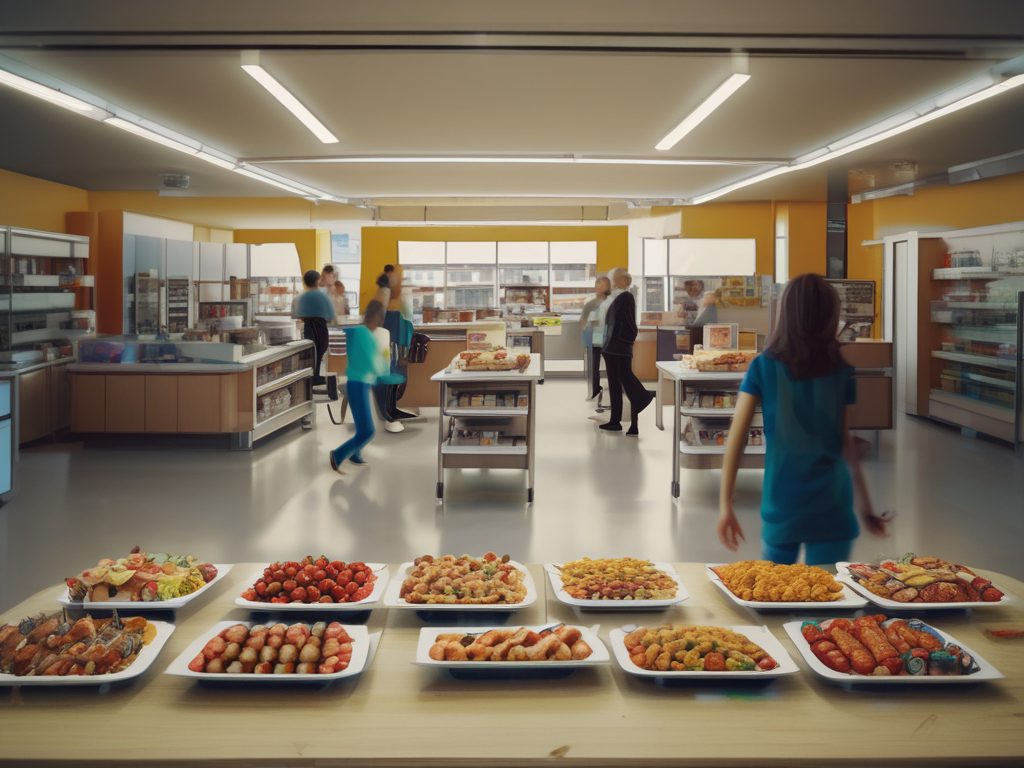
The way food is displayed and arranged in cafeterias was found in experiments conducted in schools influences the food choice kids make. Simply by rearranging the cafeteria, it was able to increase or decrease the consumption of many food items by as much as 25%.
A choice architect has the responsibility for organising the context in which people make decisions. Examples include the person who designs ballot boxes for voting, a doctor who describes alternate treatm
Small and apparently insignificant details can have major impacts on people’s behaviour. A good rule of thumb is to assume that ‘everything matters’. In many cases, the power of these small details comes from focusing the attention of users in a particular direction. In Schipol Airport in Amsterdam, the authorities have etched the image of a black housefly into each urinal. The staff conducted fly-in urinal trials and found that etchings reduce spillage by 80%.
People’s choices are pervasively influenced by the design elements selected by choice architects.
Libertarian Paternalism – The libertarian aspect lies in the straightforward insistence that, in general, people should be free to do what they like – and opt out of undesirable arrangements in they want to do so. Libertarian paternalists want to make it easy for people to go their own way; they do not want to burden those who want to exercise their freedom. The paternalistic aspect lies in the claim that it is legitimate for choice architects to try to influence people’s behaviour in order to make their lives longer, healthier, and better. A policy is ‘paternalistic’ if it tries to steer people’s choices in directions that will improve their lives.
II. Biases & Blunders
A. How we think : Two Systems
Beethoven wrote his incredible ninth symphony while he was deaf, but we would not be at all surprised if we learned that he often misplaced his house keys. How can people be simultaneously so smart and so dumb? Many psychologists have been converging on a description of the brain’s functioning that helps us make sense of these seeming contradictions. The approach involves a distinction between two kinds of thinking, one that is intuitive and automatic, and another that is reflective and rational.
a. The Automatic System (also referred to as System 1) is rapid and is or feels instinctive, and it does not involve what we usually associate with the word thinking. When you duck because a ball is thrown at you unexpectedly, or smile when you see a cute puppy, you are using your Automatic system. Brain scientists are able to say that the activities of this system are associated with the oldest parts of the brain, the parts we share with lizards (as well as puppies).
b. The Reflective System (System 2) is more deliberate and self-conscious. We use it when we are asked, ‘How much is 411 times 37?’ Most people are also likely to use the Reflective System when deciding which route to take for a trip and whether to go to business school or law school.
People speak their native language using their Automatic Systems and tend to struggle to speak another language using their Reflective Systems. Being truly bilingual means that you speak two languages using the Automatic System. Accomplished chess players and professional athletes have pretty fancy intuitions; their Automatic Systems allow them to size up complex situations rapidly and to respond with both amazing accuracy and exceptional speed. The Automatic System starts out with no idea how to play golf or tennis. Note, however, that countless hours of practice enable an accomplished golfer to avoid reflection and to rely on her Automatic System. The Automatic System can be trained with lots of repetition – but such training takes a lot of time and effort.
Humans sometimes use the Automatic System intuitively instead of consulting the Reflective system which leads to errors in decision making.
B. Rules of Thumb
Most of us are busy, our lives are complicated, and we can’t spend all our times thinking and analysing everything. We use simple rules of thumb to help us and they are quick and useful. Although rules of thumb can be very helpful, their use can also lead to systematic biases.
Amos Tversky and Daniel Kahneman identified three heuristics, or rules of thumb – anchoring, availability, and representativeness and the biases that are associated with each.
These heuristics and biases emerge from the interplay between Automatic System and Reflective System.
a. Anchoring: In the language of this book, anchors serve as nudges. We can influence the figure you will choose in a particular situation by ever-so-subtly suggesting a starting point for your thought process. When charities ask you for a donation, they typically offer you a range of options such as $100, $250, $1,000, $5,000, or ‘other’. These value are not random because the options influence the amount of money people decide to donate. People will give more if the options are $100, $250, $1,000 and $5,000, than if the options are $50, $75, $100, and $150.
In many domains, the evidence shows that, within reason, the more you ask for, the more you tend to get. Lawyers who sue cigarette companies often win astronomical amounts, in part because they have successfully induced juries to anchor on multimillion-dollar figures. Clever negotiators often get amazing deals for their clients by producing an opening offer that makes their adversary thrilled to pay half that very amount.
b. Availability: Most people use the availability heuristic to assess the likelihood of risks by asking how readily examples come to mind. Homicides are more available than suicides, and so people tend to believe, wrongly, that more people die from homicide.
Accessibility and salience are closely related to availability, and they are important as well. If you have personally experienced a serious earthquake, you’re more likely to believe than an earthquake is likely than if you have read about it. Thus vivid and easily imagined causes of death (for example, tornados) often receive inflated estimates of probability, and less-vivid causes (for example, asthma attacks) receive low estimates, even if they occur with far greater frequency (here a factor of twenty). So too, recent events have a greater impact on our behaviour, and our fears, than earlier ones.
In all these highly available examples, the Automatic system is keenly aware of the risk (perhaps too keenly), without having to resort to any tables of boring statistics. In the aftermath of an earthquake, purchases of new earthquake insurance policies rise sharply.
c. Representativeness: We think a 7-foot African American man is more likely to be a professional basketball player than a 5.5 foot Jewish guy because there are lot of tall black basketball players and not many short Jewish ones. Use of this heuristic can cause serious misrepresentation of patters in everyday life. When events are determined by chance, such as a sequence of coin tosses, people expect the resulting string to be representative of what they think is random. Unfortunately, people do not have accurate perceptions of what random processes look like. When they see outcomes of random processes, they often detect patters that they think have great meaning but are in fact due to chance. You might flip a coin three times, see it come up heads every time, and conclude that there is something funny about the coin. But the fact is that if you flip a coin a lot, it won’t be so unusual to see three heads in a row. We often see patterns because we construct our informal tests only after looking at the evidence. Use of representativeness heuristic can cause people to confuse random fluctuations with causal patterns.
d. Optimism and Overconfidence: The ‘above average’ effect is pervasive – 90% of all drivers think that are above average behind the wheel and nearly everyone thinks he has an above-average sense of humour. People are unrealistically optimistic even when the stakes are high. About 50% of marriages end up in divorce. Unrealistic optimism can explain a lot of individual risk taking, especially in the domain of risks to life and death. Gay men systematically underestimate the chance that they will contract AIDS, even though they know about AIDS risks in general. Lotteries are successful partly because of unrealistic optimism.
e. Gains and Losses: People hate losses (and their Automatic Systems can get pretty emotional about them). Roughly speaking, losing something makes you twice as miserable as gaining the same thing makes you happy. Loss aversion helps produce inertia, meaning a strong desire to stick with your current holdings. If you are reluctant to give up what you have because you do not want to incur losses, then you will turn down trades you might have otherwise made.
f. Status Quo Bias: For lots of reasons, people have a more general tendency to stick with their current situation. This bias is easily exploited. Magazine subscriptions with auto renewal seem like a bargain even if they are hardly read, unless an action is taken cancel it, subscription continues. Network executives spend a lot of time working on scheduling because they know that a viewer who starts the evening with NBC tends to stay there. When one show ends and the next ones comes on instantly, a surprisingly large number of viewers continue watching.
The combination of ‘loss aversion’ with mindless choosing implies that if an option is designated as the default, it will attract a large market share. Default options thus act as a powerful nudge.
g. Framing: The idea is that choices depend, in part, on the way in which problems are stated. For energy conservation, consider the following information campaigns: (a) If you use energy conservation methods, you will save $350 per year; (b) If you do not use energy conservation methods, you will lose $350 per year. It turns out that information campaign (b), framed in terms of losses is far more effective than (a). Framing works because people tend to be somewhat mindless, passive decision makers. Their Reflective System does not do the work that would be required to check and see whether reframing the questions would produce a different answer. This implies that frames are powerful nudges, and must be selected with caution.
The picture that emerges is one of busy people trying to cope in a complex world in which they cannot afford to think deeply about every choice they have to make. As a result, people shall we say are nudge-able.
III. Resisting Temptation
A. Temptation
Most people realise that temptation exists, and they take steps to overcome it. The classic example is that of Ulysses, who faced the peril of the Sirens and their irresistible songs. While in a cold state, Ulysses instructed his crew to fill their ears with wax so that they would not be tempted by the music. He also asked the crew to tie him to the mast so that he could listen for himself but be restrained from submitting to the temptation to steer the ship closer when the music put him into a hot state.
Ulysses successfully solved his problems. For most of us, however, self-control issues arise because we underestimate the effect of arousal. This is something behavioural economist George Lowenstein call the ‘hot-cold empathy gap.’ When in a cold state, we do not appreciate how much our desires and our behaviour will be altered when we are ‘under the influence’ of arousal. As a result, our behaviour reflects a certain naiveté about the effects that context can have on choice.
Self-control problems can be illuminated by thinking about an individual as containing two semiautonomous selves, a far sighted ‘Planner’ and a myopic ‘Doer’. You can think of Planner as speaking for your Reflective System and Doers as heavily influenced by the Autonomous System. The Planner is trying to promote your long-term welfare but must cope with the feelings, mischief, and strong will of the Doer, who is exposed to the temptations that come with arousal.
B. Mindless Choosing
In many situations, people put themselves into ‘an auto pilot’ mode, in which they are not actively paying attention to the task at hand (The Automatic System is very comfortable that way). We often find ourselves easily driving our usual route to work – until we realise we are headed in the opposite direction. Eating turns out to be one of the most mindless activities. Many of use simply eat whatever is put in front of us. That is why massive bowls of cashews are likely to be consumed completely, regardless of the quality of food that is soon to be arriving.
C. Self-control strategies
Since people are at least partly aware of their weaknesses, they take steps to engage outside help. We make lists, buy alarm clocks, ask friends to stop us from having dessert. Unfortunately, Doers are often difficult to rein in and can lead to a fierce battle between Doer and Planner. Some states in US have attempted to help gamblers by creating mechanism by which they can put themselves on a list of people banned from casinos.
IV. Following the Herd
The Reverend Jim Jones was the founder and leader of the People’s Temple. In 1978 Jones, facing charges of tax evasion, moved most of his one thousand followers from San Francisco to a small settlement in Guyana. Facing a federal investigation for reported acts of child abuse and torture, Jones decided that his followers should poison their children and then themselves. A few people resisted, a few shouted out their protest, but were silenced. Following Jones’s orders, and the social pressures imposed by one another, mothers and fathers duly poisoned their children. Then they poisoned themselves. Their bodies were found arm in arm, lying together.
Humans are not exactly lemmings, but they are easily influenced by the statements and deeds of others. Yawns are contagious, conventional wisdom has it that two people lie together for a long time, they start to look like each other. For the curious: they grow to look alike partly because of nutrition – shared diets and eating habits – not much of the effect is simple imitation of facial expressions.
Most people learn from others and learning from others is how individuals and societies develop. But many of our biggest misconceptions also come from others. When social influences have caused people to have false or biased beliefs, then some nudging may help.
Social influences come in two basic categories. The first involves information. If many people do something or think something, their actions and their thoughts convey information about what might be best for you to do or think. The second involves peer pressure. If you care about what other people think about you, then you might go along with the crowd to avoid their wrath or curry their favour. Consider the following research findings:
- Obesity is contagious. If you’re best friends get fat, your risk of gaining weight goes up.
- Teenage girls who see that other teenagers are having children are more likely to become pregnant themselves.
The bottom line is that Humans are easily nudged by other Humans. Why? One reason is that we like to conform.
A. Doing what Others Do
Why, exactly, do people sometimes ignore the evidence of their own senses? We have already sketched the two answers. The first involves the information conveyed by people’s answers; the second involves peer pressure and the desire not to face the disapproval of the group.
Based on Confirmation experiments conducted over the years, social scientists found that People become more likely to conform when they know that other people will see what they have to say. Unanimous groups are able to provide the strongest nudges – even when the question is an easy one, and people ought to know that everyone else is wrong.
Other experiments found that, if a little nudge, if it was expressed confidently, could have major consequences for the group’s conclusion. The clear lesson is that consistent and unwavering people, can move groups and practices in their preferred direction. More remarkably still, the group’s judgements became thoroughly internalised, so that people would adhere to them. Even when enough fresh subjects were introduced and others retired so that all participants were new, the original group judgements tended to stick, although the person who was originally responsible for it had long gone.
Arbitrary traditions can become entrenched over time, so that many people follow it notwithstanding its original arbitrariness. We can see here why many groups fall prey to what is known as ‘collective conservatism’: the tendency of groups to stick to established patterns even as new needs arise. Once a practice (like wearing ties) has been established, it is likely to be perpetuated, even if there is no particular basis for it.
An important problem here is ‘pluralistic ignorance’ – we may follow a practice or tradition not because we like it, but merely because we think that most other people like it. Many social practices persist for this reason, and a small shock, or nudge, can dislodge them. A dramatic example is communism in the former Soviet bloc, which lasted because people were unaware how many people despised the regime.
B. The Spotlight Effect
On reason why people expend so much effort conforming to social norms and fashions is that they think that others are closely paying attention to what they are doing. People are paying less attention to you than you believe. If you have a stain on your shirt, don’t worry, they probably won’t notice. But in part because people do think that everyone has their eyes fixed on them they confirm to what they think people expect.
C. Cultural change, Political change, and Unpredictability
Individuals are far more likely to download songs that has been previously downloaded in significant numbers. Most songs could become more popular or unpopular, with much depending on the choices of the first downloaders. In many domains people are tempted to think, after the fact, that an outcome was entirely predictable, and the success of a musician, an actor, an author, or a politician was inevitable in light of his or her skills and characteristics. Beware the temptation. Small interventions and even coincidences, at a key stage, can produce large variations in the outcome.
An especially good way to gain weight is to have dinner with other people. On average, those who eat with one other person eat about 35% more than they do alone; members of a group of four eat about 75% more, those in groups of seven or more eat 96% more.
Advertisers are aware of the power of social influences. They frequently emphasize that ‘most people prefer’ their product, or that ‘growing number of people’ are switching from another brand. They try to nudge you what other people are doing.
In many nations, candidates for public office, or political parties emphasize that ‘most people are turning to’ their preferred candidates, hoping that the very statement can make itself true.
People’s investment decisions are influenced by the investment decisions of their friends and family. Robert Shiller contends that ‘the most important single element to be reckoned with in understanding this or any other speculative boom is the social contagion of boom thinking, mediated by the common observation of rapidly rising prices. He urges that in the process of social contagion, public knowledge is subject to a kind of escalation or spiral, in which most people come to think that optimist view is correct, simply because everyone else seems to accept it. As the media endorses that view, people end up believing that we are in a ‘new era’, and feedback loops help to bring about ever-increasing prices. In his words, the ‘price-story-price loop repeats again and again during a speculative bubble.’ Eventually the bubble is bound to pop, because it depends on social judgements that cannot be sustained over the long term.
D. Social Nudges As Choice Architecture
Information & Peer Pressure: The general lesson is clear. If choice architects want to shift behaviour and to do so with a nudge, they might simply inform people what other people are doing. Either desirable or undesirable behaviour can be increased, at least to some extent, by drawing public attention to what others are doing. Note to Political parties: If you would like to increase turnout, please do not lament the large number of people who fail to vote.
Montana applies the same approach to cigarette smoking with an ad suggesting that ‘Most (70 %) of Montana tends are tobacco free.’ The strategy has produced big improvements in the accuracy of social perceptions and also statistically significant decreases in smoking.
Social nudges can also decrease energy use. Consider a study of the power of social norms, involving three hundred households in San Marcos, California. All of the households were informed about how much energy they used in previous weeks; they were also given information about the average consumption by households in their neighbourhood. The effects on behaviour were both clear and striking. In the following weeks, the above-average energy users significantly decreased their energy use; the below-average energy users significantly increased their use.
The latter finding is called a boomerang effect, and it offers an important warning. If you want to nudge people into socially desirable behaviour, do not, by any means, let them know that their current actions are better than the social norm.
Priming: Priming refers to the somewhat mysterious workings of the Automatic System of the brain. Research shows that subtle influences can increase the ease with which certain information comes to mind. In surveys, people are often asked whether they are likely to engage in certain behaviour – to vote, to lose weight, to purchase particular products. Those who engage in surveys want to catalogue behaviour, not to influence it. But social scientists have discovered an off fact when they measure people’s intentions, they affect people’s conduct.
The ‘mere measurement effect’ refers to the finding that when people are asked what they intend to do, they become more likely to act in accordance with their answers.
It is found that campaign officials can increase the probability of voting amongst its supporters by as much as 25% by simply asking their supporters, the day before the elections, whether they intend to vote. A study of nationally representative sample of more than 40,000 people asked a simple questions: Do you intend to buy a new car in the next 6 months? The very question increased purchase rates by 35%.
The nudge provided by asking people what they intend to do can be accentuated by asking them when and how they plan to do it.
This insight falls into the category called ‘channel factors’, a term used for small influences that could either facilitate or inhibit certain behaviours. Social scientists have found that they can ‘prime’ people into certain forms of behaviours by offering simple and apparently irrelevant cues. It turns out that if certain objects are made visible and salient, people’s behaviour can be affected.
Mere exposure to the scent of an all-purpose cleaner makes people keep their environment cleaner while they eat. Or consider this one: people’s judgement about strangers are affected by whether they are drinking iced coffee or hot coffee! Those given iced coffee are more likely to see other people as more selfish, less sociable, and, well, colder than those who are given hot coffee. This, too happens quite unconsciously.
The three social influences – information, peer pressure, and priming – can be easily used to promote many good (and bad) causes.
V. Why Do We Need a Nudge?
We have seen that people perform amazing feats but also commit dirty blunders. What’s the best response? Choice architecture and its effects cannot be avoided, and so, the short answer is an obvious one, call it the golden rule of libertarian paternalism: offer nudges that are most likely to help and least likely to inflict harm.
If you are a choice architect you are trying to design the choice environment. What do you need to know to design the best possible choice environment?
A. Benefits Now – Costs Later
We have seen that predictable problems arise when people must make decisions that test their capacity for self-control. Self-control issues are most likely to arise when choices and their consequences are separated in time, at one extreme are what might be called investment goods, such as exercise, flossing, and dieting. For these goods the costs are borne immediately, but the benefits are delayed. At the other extreme are what might be called sinful goods: smoking, alcohol, and jumbo chocolate doughnuts. We get the pleasure now and suffer the consequences later.
B. Degree of Difficulty
Many problems in life are quite difficult. We are more likely to need more help picking the right mortgage than choosing the right loaf of bread.
C. Frequency
Some of life’s most important decisions do not come with many opportunities to practise. Generally, the higher the stakes, the less often we are able to practice. Most of us buy houses and cars not more than once or twice a decade, but we are really practiced at grocery shopping. Rare, difficult choices are good candidates for nudges.
D. Feedback
Learning is most likely if people get immediate, clear feedback after each try. In a game of golf, suppose you were putting golf balls but not getting to see where they were going. In that environment, you could putt all day and never get any better. Someone can eat a high-fat diet for years without having any warning signs until the heart attack. When feedback does not work, we may benefit from a nudge.
E. Knowing what you like
It’s particularly hard for people to make good decisions when they have trouble translating the choices they face into the experiences they will have. Consider the various investment options. When people have a hard time predicting how their choices will end up affecting their lives, they have less to gain by numerous options and perhaps even by choosing for themselves. A nudge might be welcomed.
F. Markets: A Mixed Verdict
People may most need a good nudge for choices that have delayed effects; those that are difficult, infrequent, and offer poor feedback; and those for which the relation between choice and experience is ambiguous. A natural question is whether free markets can solve people’s problems, even under such circumstances. Often market competition will do a lot of good. But in some cases, companies have a strong incentive to cater to people’s frailties and to exploit them.
If consumers have a less than fully rational belief, firms often have more incentive to cater to that belief than to eradicate them. When many people were afraid of flying, it was common to see airline flight insurance sold at airports at exorbitant prices. There were no booth in airports selling people advice not to buy such insurance.
In many markets, firms will be competing for the same consumers but will be offering products that are not merely different but that directly oppose each other. Some firms sell cigarettes; others sell products that help you quit smoking. If all consumers are Econs, then there is no reason to worry about which of these competing interests win. But if some of the consumers are Humans who sometimes make bad choices, then all of us may have an interest in which set of firms wins the battle. Government can, of course, outlaw some kinds of activities, but as libertarian paternalists we prefer to nudge – and we are keenly aware that governments are populated by Humans.
VI. Choice Architecture
Stimulus response compatibility – the idea is that you want signal you receive (the stimulus) to be consistent with the desired action. When there are inconsistencies, performance suffers and people blunder.
Consider, for example, the effects of a large, red, octagonal sign that said GO or GREEN displayed in RED. For these incompatible signals, response time slows and error rates increase. A key reason is that the Automatic System reads the word faster than the color naming system can decide the color of the text. Flat plates say ‘push me’ and big handles say ‘pull me’.
No piece of choice architecture has received as much attention as the now famous fly in the Amsterdam airport urinals. Putting a fake fly, reduced spillage by 80%, and extraordinary nudging success.
A. Defaults: Padding The Path Of Least Resistance
Many people will take whatever option requires the least resistance. Recall inertia, status quo bias, and the ‘yeah whatever’ heuristic. All these forces imply that of, for a given choice, there is a default option – an option that will obtain if the chooser does nothing – then we can expect a large number of people to end up with that option, whether or not it is good for them. Defaults are ubiquitous and powerful.
Remember the idea of successful renewal of magazines subscriptions. When you download a new software, you will often have numerous choices to make. Normally, one of the boxes is already checked, indicating the default.
B. Expect Error
Humans make mistakes. A well-designed system expects its users to err and is as forgiving as possible. Post completion error – when you have finished your main task, you tend to forget things relating to previous steps.
Examples include leaving ATM cars in the machine after withdrawing money. Most ATMs no longer allow this error because you get you card back immediately. Automobile related good design involves nozzles for different varieties of gasoline. The nozzle that deliver diesel fuel are too large to fit into the opening on cars that use gasoline.
A major problem in health care is called ‘drug compliance.’ Birth control pills are taken every day for three weeks and then skipped for one week. To solve this problem and to make the process automatic, the pills are typically sold in a special container that contains 28 pills, each in a numbered compartment. The pills for days twenty-two through twenty-eight are placebos whose role is to facilitate compliance. Once a day is much better than once every other day, because taking a pill becomes a habit, and habits are controlled by the Automatic Systems.
C. Give Feedback
Well-designed systems tell people when they are doing well and when they are making mistakes. Digital cameras provide better feedback than film cameras – after each shot, the photographer can see a version of the image just captured. When a picture is taken, there is an audible click to indicate that the image has been captured. Our laptops warn us to plug in when the battery is dangerously low.
D. Understanding ‘Mappings’: From Choice to Welfare
Some tasks are easy, like choosing a flavour of ice cream; other tasks are hard, like choosing a medical treatment.
Selecting an ice cream to eat is merely a matter of choosing the one that tastes best. People will be able to predict with considerable accuracy the relation between their choice and their ultimate consumption experience. Call this relation between choice and welfare a mapping. Even if there are some exotic flavours, the store can solve the mapping problem by offering a free taste.
Choosing among treatments for some disease is quite another matter. Each of the treatment options comes with complex set of possible outcomes regarding side effects, quality of life, length of life and so forth.
A good system of choice architecture helps people to improve their ability to map and hence to select options that will make them better off. One way to do this is to make the information about various options more comprehensible, by transforming numerical information into units that translate more readily into actual use. Credit cards are not alone in having complex pricing schemes that are neither transparent nor comprehensible to consumers. Think about mortgages, cell phone plans and auto insurance policies, just to name a few.
E. Structure Complex Choices
When we face a small number of well-understood alternatives, we tend to examine all the attributes of all the alternatives and then make trade-offs when necessary. But when the choice set gets large, we must use alternative strategies, and these can get us into trouble. As choices become more numerous, though, good choice architecture will provide structure, and structure will affect outcomes. Netflix offers an immensely helpful choice architecture – search movies by actor, director, genre, and more, if they rate the movies they have watched, they can also get recommendations.
F. Incentives
Standard economic forces of supply and demand. Many markets are replete with incentive conflicts. The U.S. heath care system. The patient receives heath care services that are chosen by his physician and paid by the insurance company, with everyone from equipment manufacturers to drug companies to malpractice lawyers taking a piece of the action.
We have sketched six principles of good choice architecture – iNcentives, Understanding mappings, Defaults, Give feedback, Expect error, Structure complex choices. With an eye on these NUDGES, choice architects can improve the outcomes for their Human users.